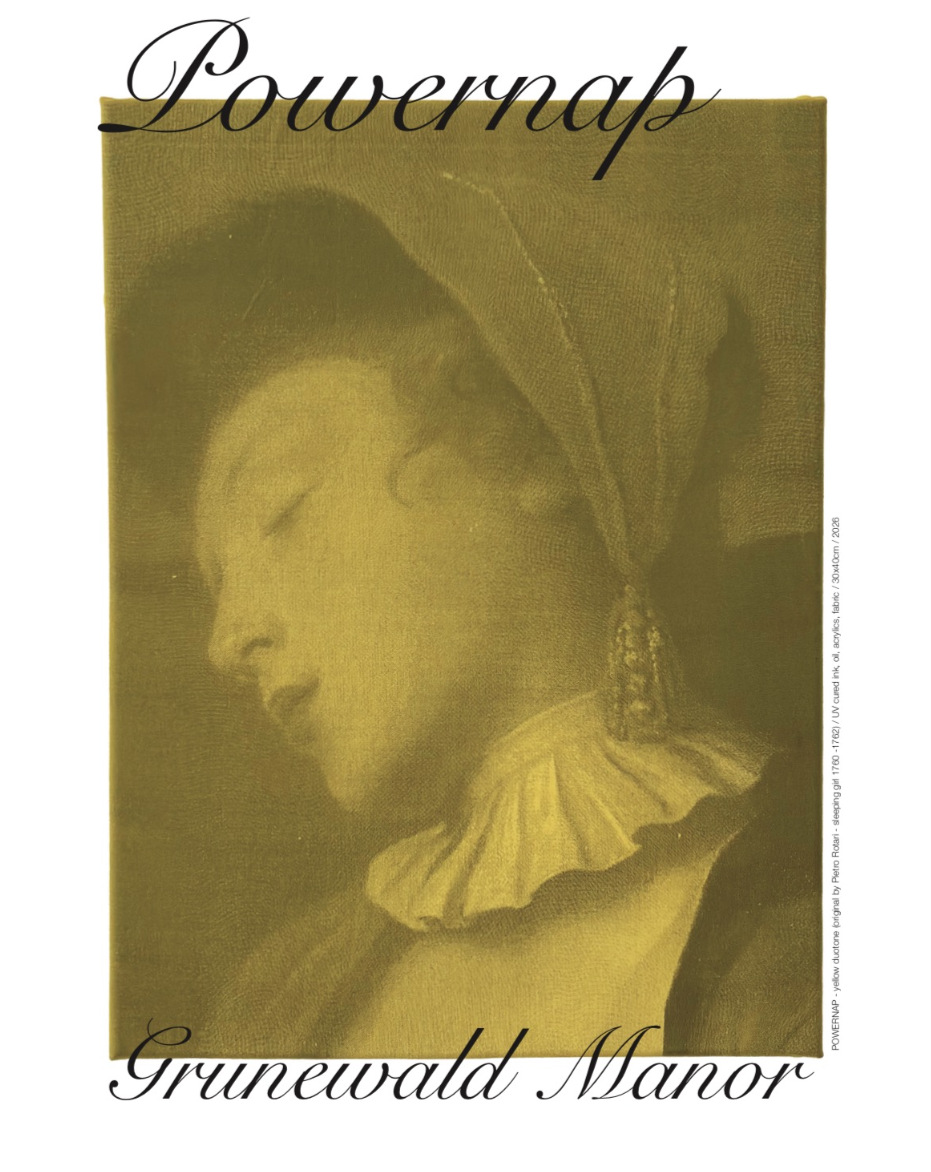
Powernap
Within this exhibition, Manor Grunewald brings together a collection of painted & printed portraits.
In close-up, the works depict people who have surrendered themselves to sleep: eyes closed, faces relaxed, the world temporarily held at a distance.The selected portraits span a long period of art history. Despite their diverse origins, styles, and eras, they share a remarkable sense of stillness. Sleep renders the figures both vulnerable and, at the same time, untouchable. They seem to momentarily detach themselves from reality, entering an in-between space where time, surroundings, and everyday concerns recede into the background.
Powernap approaches these paintings as images of rest, but also as expressions of longing. The sleeping figure is not presented in action, but in a state of surrender. Closed eyes leave room for imagination: what happens within the dreamer's inner landscape? Where does someone exist when they are, for a moment, absent from the visible world? At first glance, the works on canvas carry a romantic quality. The sleeping face evokes associations with dreams, intimacy, silence, and peaceful serenity. At the same time, something elusive remains. The painter can capture the face, the posture, and the atmosphere, but not the dream itself. The portrait thus becomes a momentary record of a state that largely escapes our gaze.
Grunewald brings these images of sleep together as a temporary space of slowing down. A space in which painting does not merely depict someone, but also evokes a feeling: the desire for rest, for escape from the constant presence of the world, for a moment in which everything briefly comes to a standstill.
At the centre of the gallery space stands a sculptural installation featuring the logos of sleeping pills. This object introduces a second face of Powernap. The installation interrupts the stillness of the paintings and invites us to look at the sleeping figures anew. What initially appears as an image of rest, dreaming, and peaceful surrender can also be understood through the lens of a contemporary experience of exhaustion.
The portraits consequently take on an ambiguous meaning. On the one hand, sleep represents a desire for escape, a temporary pause from the outside world. On the other, it points towards a society in which rest is becoming increasingly difficult to take for granted. In an accelerated society driven by economic growth, constant connectivity, self-promotion, and the pursuit of success, even rest can seem to become something that must be organised, produced, or supported.In this context, the sleeping pill becomes an ambiguous symbol. It represents the desire for silence and recovery, while at the same time raising the question of why such rest no longer seems to come naturally. The romantic dream of the sleeping figure acquires a contemporary counterpoint: one of fatigue, mental overload, and the feeling of having to remain functional at all times.
The portraits therefore invite a second reading. The closed eyes of the figures can be understood not only as an image of serenity, but also as a temporary withdrawal from a world that increasingly demands from the individual. Behind the calmness, exhaustion emerges; behind the dream, the need for recovery.On the one hand, sleep is a universal and timeless image of intimacy, vulnerability, and peace of mind. On the other, it becomes a mirror of the present, in which mental exhaustion, depression, burnout, and a broader experience of collective fatigue are becoming increasingly pronounced.
Grunewald thus opens up a space between desire and necessity, between dream and exhaustion, between voluntary withdrawal and the inability to participate. The figures do not look back at us as spectators. Precisely because of this, they compel us to look ourselves: at our relationship to rest, at the pressure to remain constantly active and visible, and at what happens when the body ultimately puts on the brakes itself.
It is an exhibition about the need to simply be, for a moment, without having to be anything at all.